Context
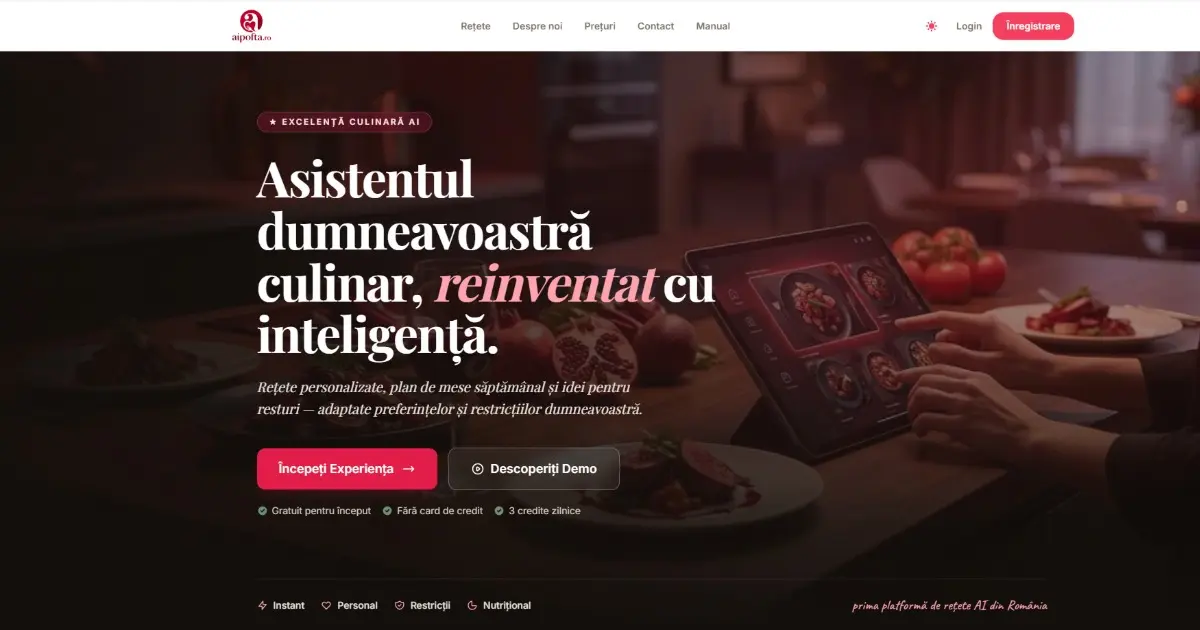
Deciding what to cook is a small problem that comes back every day. Recipe sites are written for an average eater, but real households live with food allergies, conditions such as diabetes or celiac disease, children of different ages, a limited set of kitchen equipment and whatever happens to be in the fridge. Adapting a recipe to all of that by hand takes time, and leftovers often end up in the bin. AIpoftă is our own product, built for home cooks in Romania who want recipes that fit their household, not the other way round.
What we built
AIpoftă is a Romanian-language web app that works as a personal cooking assistant. A short onboarding wizard and a cooking profile capture what matters: skill level, available time, household size, dietary restrictions, health conditions, kitchen equipment and children. The user then picks ingredients and receives a complete recipe with steps, timings, nutritional values and a photo. The same profile drives a seven-day meal planner with a shopping list, a kids' recipe generator for four age groups, and a tool that turns leftovers into quick meals. Users keep favourites, ask for variations and can publish their best recipes to a public collection, where visitors browse, comment and rate them. An administrator moderates comments and manages users and recipes from a dedicated admin panel.
Key features
- Personalised recipes – every recipe respects the user's allergies, diet, health conditions, skill level and equipment, so there is nothing left to adapt.
- Weekly meal planner – a full seven-day plan with a shopping list grouped by category, built around budget, available time and the family's goals.
- Recipes for children – dishes tailored to four age groups, from toddlers to preteens, with texture guidance and tips for picky eaters.
- Cooking from leftovers – users list what is left in the fridge and get several quick ideas with food-safety advice, without spending credits.
- Variations, servings and substitutions – a recipe can become vegetarian, vegan or gluten-free, be scaled to another number of servings, or suggest a replacement for a missing ingredient.
- Public recipe collection – users publish their favourite recipes, visitors filter and comment on them, and every page is ready for search engines.
- Pay-as-you-go credits – new accounts get free credits that top up daily, and extra credit packs are bought by card through Stripe.
Under the hood
Recipes are written by Anthropic's Claude models. Every answer is forced into a fixed structure, so each recipe arrives complete and in the same format, and unrealistic nutritional values are caught before the user sees them. Full recipes use Claude Sonnet, while quick tasks such as scaling and substitutions use the faster, cheaper Claude Haiku. Generation runs in background jobs, so the user watches progress instead of a frozen page, and the photo, made with a FLUX model through FAL.AI, follows separately. Credits are deducted inside locked database transactions and refunded automatically if a generation fails, so nobody pays for a recipe they did not get. Public pages also serve clean Markdown, an llms.txt file and a sitemap, which helps search engines and AI assistants find the recipes.
Outcome
AIpoftă is live at aipofta.ro. Anyone can open an account and get recipes that account for their allergies, health, children and pantry, plan a whole week with a ready-made shopping list, or turn leftovers into a proper meal. Published recipes grow into a public collection built to be found through search. For us, it is also a working example of how we bring large language models into a product that is dependable, keeps AI costs under control and is pleasant to use.